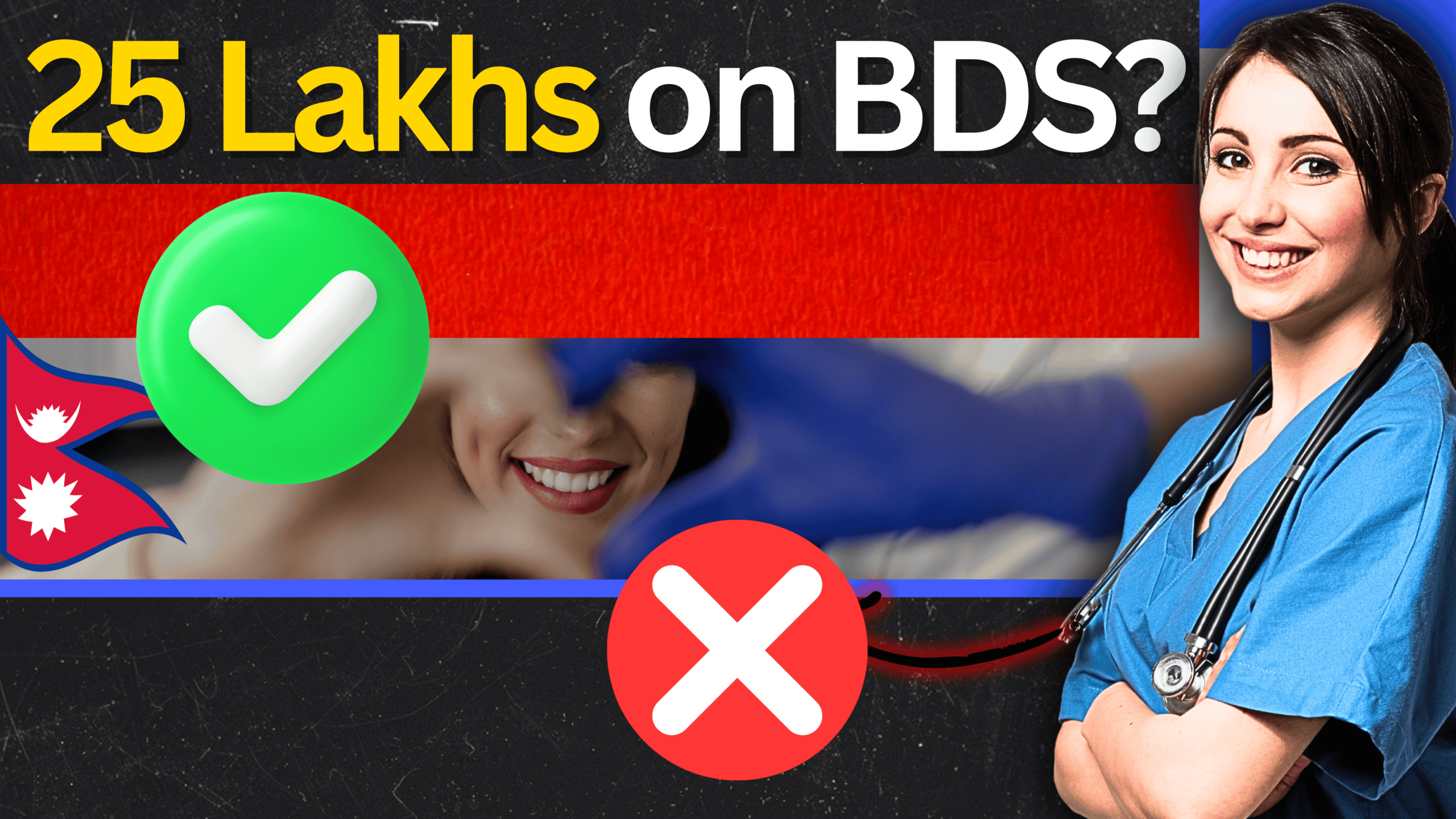
Spending 25 Lakhs on BDS? Read This Before You Sign the Bank Loan (2025 Reality)
is BDS study in paying really worth it:
It’s the week after the CEE results. The dust has settled. You didn’t get the MBBS seat you wanted, or maybe you missed the scholarship cut-off by a heartbreaking 5 marks.
Now, you are at a crossroads.
On one side, there is the “Drop Year”—another year of frustration, coaching centers in Putalisadak, and nagging relatives.

On the other side, there is an offer letter for a BDS (Bachelor of Dental Surgery) Paying Seat.
The price tag? Officially, around Rs. 20 Lakhs. Realistically? Closer to Rs. 25-30 Lakhs once you add food, hostel, and those expensive dental kits.
See BDS College Predictor . VIEW
Your father is ready to take the loan from Nabil Bank. He says, “J hos Doctor ta hunchas” (At least you will be a Doctor).
But you are hesitating. You’ve heard the rumors.
“Dentists don’t get jobs.”
“The salary is only Rs. 15,000.”
“Kathmandu has a dental clinic in every galli.”
So, the million-rupee question is:
Is studying BDS in the Paying Category really worth it in 2025?
I’m not here to give you a motivational speech. I’m here to do the math. Let’s look at the Return on Investment (ROI), the market saturation, and the exit strategies.
is BDS study in paying really worth it:
Is a BDS Paying Seat worth the investment in Nepal?
The short answer is: YES, but only if you have a specific plan.
If you expect to graduate and immediately earn Rs. 50,000/month in Kathmandu, it is NOT worth it. The market is saturated, and starting salaries are low (Rs. 18k-25k). However, BDS is highly worth it if:
- You plan to open a clinic in a semi-urban area (outside Valley).
- You use it as a gateway to the USA/Australia (cheaper than MBBS).
- You are passionate about surgery and have the capital to set up your own practice. Verdict: It is a high-skill business degree, not just a job degree.
The Core Issue: The “Second Choice” Syndrome
Let’s be real. For 80% of students, BDS is the “Second Wife.” You wanted MBBS(VIEW). You settled for BDS.
This mindset is dangerous. If you enter a Paying Seat with resentment, you will hate every rupee you spend.
The core issue in 2025 is Inflation vs. Income.
The cost of dental education has gone up (MEC hiked fees). The cost of dental equipment (imported from Germany/China) has gone up. But the price of a “Tooth Extraction” in Kathmandu? It’s still stuck at Rs. 500 because of fierce competition.
You are investing Rs. 25 Lakhs. To recover that amount with a salary of Rs. 20,000, it would take you 10 years (assuming you save 100% of your income, which is impossible).
So, mathematically, the job route fails. But the business route? That’s a different story.
The Financial Breakdown: The Real Cost vs. Return
is BDS study in paying really worth it:
Let’s strip away the brochure pricing and look at what your bank account will actually bleed.
The Investment (What You Pay)
Estimates for a Private College in 2025.
| Expense Head | Estimated Cost (4.5 Years) | Notes |
| MEC Tuition Fee | Rs. 20.9 Lakhs | Fixed by Govt. Paid in installments. |
| Hostel & Mess | Rs. 6 – 8 Lakhs | Mandatory in many colleges. |
| Dental Kits/Books | Rs. 2 – 3 Lakhs | You buy your own phantom head teeth, burs, files. |
| Exam/Reg Fees | Rs. 1.5 Lakhs | University charges. |
| TOTAL COST | **~ Rs. 30 – 33 Lakhs** | This is your Debt. |
The Return (What You Earn)
Starting Salary in Year 1 after Internship.
| Job Type | Monthly Salary (Est.) | Reality Check |
| Private Clinic (KTM) | Rs. 15,000 – 20,000 | Exploitative. Often commission-based. |
| Hospital Officer | Rs. 35,000 – 42,000 | Very competitive. Few vacancies. |
| Lok Sewa (Govt) | Rs. 45,000+ | The Gold Standard. Extremely hard to crack. |
| Own Clinic | Rs. -50k to +1 Lakh | High risk. Needs Rs. 15 Lakhs setup cost. |
The Data Verdict:
If you rely solely on a private job in Kathmandu, your ROI is terrible. You are earning less than a ride-sharing driver despite spending 30 Lakhs. However, if you open a clinic in a place like Itahari, Bardibas, or Dhangadhi, you can hit break-even in 3 years.
The “Hidden” Reality: The Equipment Trap
is BDS study in paying really worth it:
Here is something agents won’t tell you. BDS is the most “equipment-heavy” course.
In MBBS, you need a stethoscope (Rs. 2,000) and books.
In BDS, you need a Handpiece, Articulator, Diamond Burs, Root Canal Files, and endless consumables.
- The Struggle: In the 3rd and 4th year, you are constantly buying materials. If you break a file inside a patient’s tooth (on a dummy or real), you pay for it.
- The Internship Fee: As I mentioned in previous articles, some colleges charge YOU for the internship. So instead of earning, you might be paying another Rs. 1-2 Lakhs in the final year.
Ask yourself: Do your parents have a buffer fund of Rs. 3-4 Lakhs for these hidden costs?
The “Escape” Route: Why BDS is Actually Smart
So far, I’ve scared you. Now, let me tell you why I would still recommend BDS Paying to my own younger brother.
1. The “Doctor” Passport
A BDS degree from Nepal is recognized globally (with exams).
- USA: You can apply for DDS (Advanced Standing). You become a US Dentist earning $150,000+ a year. Yes, it’s hard, but the ROI is infinite.
- Australia: The ADC exam is tough, but once you pass, you are in the highest tax bracket.
2. The “Skill” Factor
An MBBS doctor needs a hospital to operate. A Dentist needs a chair.
You are an artisan. You work with your hands. If you are good at aesthetic dentistry (smile design, veneers), you can charge Rs. 20,000 for a 2-hour procedure in Nepal. The rich in Nepal will pay for beauty.
3. Less Stress, Better Life
Let’s be real. MBBS life is brutal. Night shifts, emergency trauma, life-and-death pressure.
Dentistry? No night shifts. No emergencies (mostly). You work 10 AM to 5 PM. You have weekends off. If you value work-life balance, BDS wins.
Step-by-Step Solution: How to Make It Worth It
If you decide to pay the 25 Lakhs, don’t be a “Generic Dentist.” Here is your game plan to ensure you don’t regret it.
- Don’t Stay in Kathmandu:
After graduation, pack your bags. Go to a developing municipality—places like Gaighat, Tulsipur, or Waling. The competition is zero, and people have money. You will be the “King Dentist” there. - Learn “Sales,” Not Just Surgery:
Dentistry is 50% medical and 50% business. You need to know how to talk to a patient, explain why they need a Crown, and convince them to pay. Learn soft skills during college. - Target the “Lok Sewa”:
Start preparing for the Public Service Commission exam from Year 3. A government dental job gives you a pension, respect, and a steady income that private clinics can’t match. - The “Plus Two” Strategy:
If you have the money, plan for a MDS (Masters) immediately. A General Dentist is common; an Orthodontist (Braces specialist) or Oral Surgeon is rare and highly paid.
User Intent FAQs (Real Questions from Parents)
Q: Can my son/daughter open a clinic immediately after BDS?
Legally, yes (after NMC license). Practically, No. They need at least 1-2 years of experience working under a senior dentist to learn the trade secrets and handle complications. Opening a clinic too early is a recipe for bankruptcy.
Q: Is the salary really that low (Rs. 15,000)?
In Kathmandu, yes. Supply > Demand. Clinics know fresh graduates are desperate for experience, so they exploit them. Some even work for free (Volunteers). This is why I advise moving out of the Valley.
Q: Is BDS easier than MBBS?
Academically? Maybe slightly (anatomy is focused on head/neck). Practically? No. It is physically demanding. You are hunched over a patient’s mouth for hours. Back pain and neck pain are occupational hazards. It requires high manual dexterity.
Q: What is the scope for BDS in the Nepal Army/Police?
Excellent. The Technical Officer (Lieutenant) exams for Army/Police have reserved seats for Dentists. The perks, pension, and social status are top-tier.
Q: Can I do MBBS after BDS?
No. You would have to start from scratch (CEE Entrance again). There is no “Bridge Course” in Nepal to convert BDS to MBBS. Choose wisely now.
The Bottom Line
Is studying BDS in the Paying Category worth it?
No, if you view it as a job ticket. If you think spending 30 Lakhs entitles you to a high salary instantly, you are walking into a trap. The Nepali market cannot support high salaries for fresh dentists.
Yes, if you view it as a Business License or a Visa Ticket.
It is worth it if you have the entrepreneurial spirit to set up a clinic in a rural hub.
It is worth it if you use it to catapult yourself to the US or Australia.
It is worth it if you genuinely love the art of surgery and aesthetics.
My final advice: Don’t pay 30 Lakhs just to satisfy your ego or your neighbor’s expectations. Pay it only if you are ready to hustle for the first 3 years after graduation.
Are you confused between a BDS Paying Seat and a B.Sc Nursing Scholarship? Drop your thoughts below, and I’ll help you analyze the ROI for your specific situation.