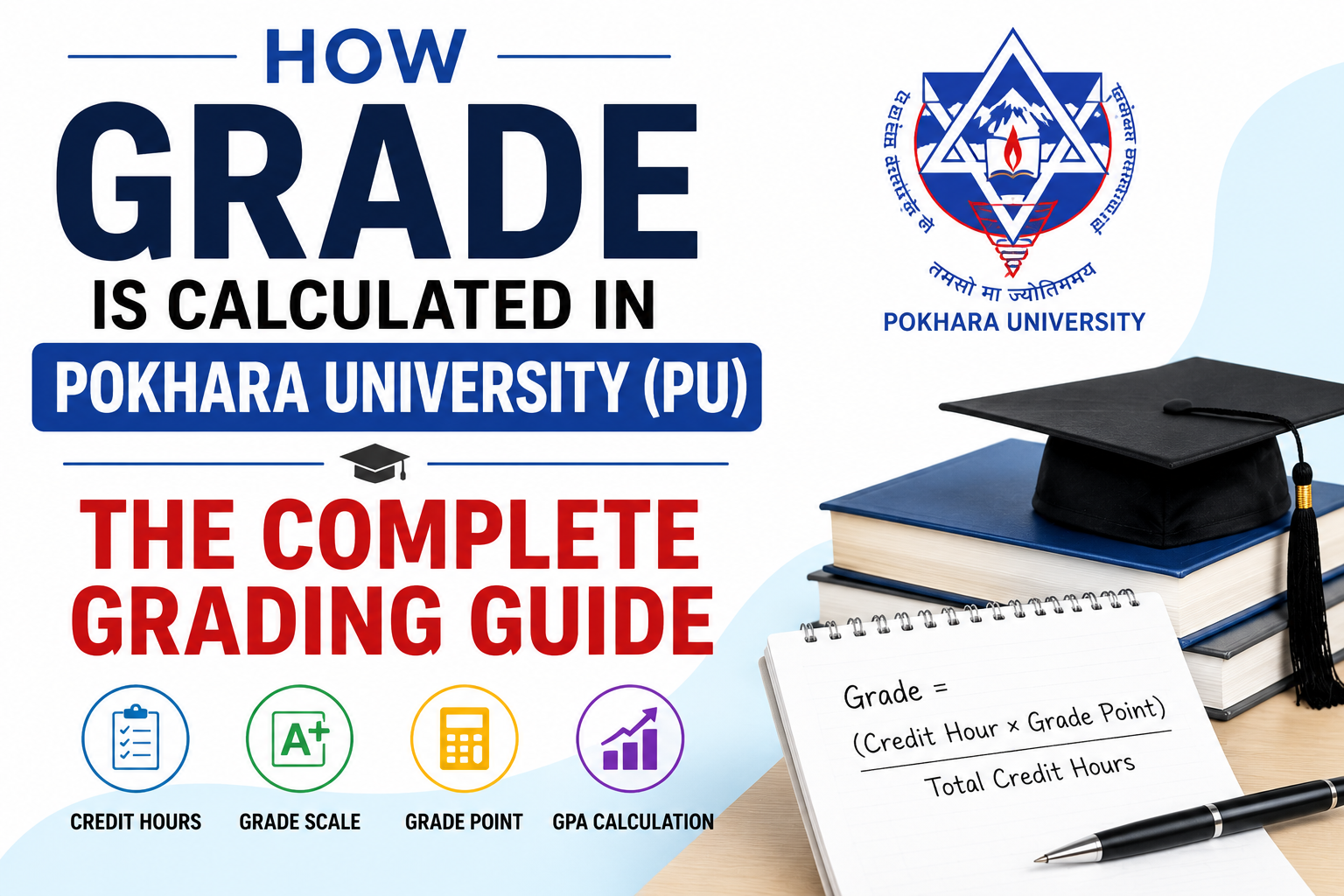
Calculate Pokhara University SGPA CGPA :
Understanding how your final GPA is calculated at Pokhara University (PU) is essential for tracking your academic progress. PU utilizes a modern four-point (4.0) Letter Grading System. Your final course mark is not determined solely by the final exam; it is a weighted combination of ongoing internal work and final external board papers.
This complete guide details the exact formulas, internal weight distributions, undergraduate versus graduate benchmarks, and step-by-step methods to calculate your SGPA and CGPA manually. It is different from the TU.
1. The Dual Evaluation Blueprint: Internal vs. External Weighting
Every course at Pokhara University divides its score between continuous inside-the-classroom grading and a final end-of-semester board examination. You must secure separate pass marks in both metrics to pass the overall course.
Total Score Apportionment Formulas
 Undergraduate Calculation:  0.50 × IEM + 0.50 × EEM = Final Composite Score
 Graduate Calculation:       0.60 × IEM + 0.40 × EEM = Final Composite Score

 * IEM = Internal Examination Marks | EEM = External Examination Marks
- Undergraduate Split (Bachelor’s Degrees): 50% Internal Assessment + 50% External Final Board Exam.
- Graduate Split (Master’s / M.Phil Degrees): 60% Internal Assessment + 40% External Final Board Exam.
What Comprises Your Internal Score (IEM)?
College faculties assess internal points throughout the semester using:
- Mid-term exams and classroom quizzes.
- Lab sessions, practical portfolios, and project work.
- Home assignments, case studies, and term papers.
- Attendance and proactive class participation.
2. Pokhara University Passing Criteria and Standard Limits
To sit for the final board exams, you must clear your internal threshold first. Students who fail the internal metrics are flagged as “Not Qualified” (NQ) and are barred from taking the external exam for that subject.
- Undergraduate Minimum Pass Mark:
- 45% in both internal and external evaluations. This translates to a minimum passing letter grade of D.
- Graduate Minimum Pass Mark:
- 60% in both internal and external evaluations. This translates to a minimum passing letter grade of C.
3. Official PU Percentage-to-Grade Scales
Once your total composite score (0 to 100) is calculated, the university assigns a fixed letter grade and matching honor points.
Undergraduate (Bachelor’s Level) Grading Scale
The Pokhara University Office of the Controller of Examinations uses this grid for bachelor programs:
| Percentage Range (%) | Grade | Points | Description / Remarks |
|---|---|---|---|
| 90 and above | A | 4.0 | Excellent |
| 85 to below 90 | A- | 3.7 | Very Good |
| 80 to below 85 | B+ | 3.3 | Good |
| 75 to below 80 | B | 3.0 | Fairly Good |
| 70 to below 75 | B- | 2.7 | Fair |
| 65 to below 70 | C+ | 2.3 | Above Average |
| 60 to below 65 | C | 2.0 | Average |
| 55 to below 60 | C- | 1.7 | Below Average |
| 50 to below 55 | D+ | 1.3 | Poor |
| 45 to below 50 | D | 1.0 | Minimum Pass Requirements |
| Below 45 | F | 0.0 | Fail |
Graduate (Master’s Level) Grading Scale
Graduate programs—such as the MBA, MCA, and M.E.—utilize a stricter conversion chart that completely removes the lower D and C- grades:
| Percentage Range (%) | Grade | Points | Description / Remarks |
|---|---|---|---|
| 90 and above | A | 4.0 | Excellent |
| 85 to below 90 | A- | 3.7 | Very Good |
| 80 to below 85 | B+ | 3.3 | Good |
| 75 to below 80 | B | 3.0 | Satisfactory |
| 70 to below 75 | B- | 2.7 | Fair |
| 65 to below 70 | C+ | 2.3 | Average |
| 60 to below 65 | C | 2.0 | Minimum Graduate Pass |
| Below 60 | F | 0.0 | Fail |
Specialized System Status Notations
- Grade “I” (Incomplete): Awarded under rare, unexpected emergencies if a student completes classes but misses a crucial final requirement (like a project deadline). You must resolve an “I” grade within the next semester, or it automatically defaults to an F.
- Grade “W” (Withdrawn): Issued if a student officially drops a course within the specified university withdrawal timelines.
4. How to Calculate Your Semester GPA (SGPA)
Your Semester Grade Point Average (SGPA) evaluates your academic performance over one specific term. It uses a weighted average system based on a course’s specific Credit Hours.
The SGPA Formula

Step-by-Step Calculation Example
Let’s calculate the SGPA for a typical Bachelor of Computer Engineering or BBA student’s term:
- Multiply the honor points of your earned grade by the credit hours of that course to get the Honor Points Earned.
- Sum up all the honor points earned across your classes.
- Divide that sum by the total credit hours registered during that semester.
| Course Name | Credit Hours (CH) | Earned Grade | Grade Honor Point (GP) | Honor Points Earned (CH × GP) |
|---|---|---|---|---|
| Mathematics III | 3 | A | 4.0 | 3 × 4.0 = 12.0 |
| Data Structures | 3 | A- | 3.7 | 3 × 3.7 = 11.1 |
| Microprocessors | 3 | B+ | 3.3 | 3 × 3.3 = 9.9 |
| Digital Logic Lab | 1 | A | 4.0 | 1 × 4.0 = 4.0 |
| Total Sums | 10 | 37.0 |
Calculated SGPA
= 37.0/10
= 3.70
5. How to Calculate Your Cumulative GPA (CGPA)
Your Cumulative Grade Point Average (CGPA) tracks your academic standing across your entire degree program. You cannot simply add your SGPAs together and divide by the number of semesters; you must use the total combined weights.
The CGPA Formula

Practical Example: Combining Multi-Semester Performance
Suppose an undergraduate student completes their first year with these metrics:
- Semester 1: 15 Credit Hours with an SGPA of 3.40
- Semester 2: 18 Credit Hours with an SGPA of 3.60
Step 1: Calculate total honor points earned over both terms:
- Semester 1 Points: 15 × 3.40 = 51.0
- Semester 2 Points: 18 × 3.60 = 64.8
- Combined Total Points: 51.0 + 64.8 = 115.8
Step 2: Calculate total credit hours attempted:
- Combined Credits: 15 + 18 = 33 credits
Step 3: Run the final division:
CGPA = 115.8 / 33 = 3.51
6. Graduation Award Classifications
Upon completing your complete degree program, Pokhara University classifies your certificate based on your final cumulative CGPA:
- Dean’s List / Distinction Standing: 3.60 to 4.00 CGPA (Undergraduate) or 3.75 to 4.00 CGPA (Graduate).
- First Division Standing: 3.00 to 3.59 CGPA.
- Second Division Standing: 2.00 to 2.99 CGPA.
Note: To successfully secure your degree certificate, undergraduate students must maintain an overall minimum CGPA of 2.0, and graduate students must maintain a minimum CGPA of 3.0. If your CGPA drops below these lines, you must clear backlog chance exams to pull your average up before graduation approval.
The 25-Mark Mark Discrepancy Rule: The Unofficial Grade Adjustment
There is a crucial, hidden rule in the Pokhara University grading manual that catches many students off guard: the internal vs. external variance limit. PU utilizes relative elements alongside its absolute framework. If the difference between your Internal Examination Marks (IEM) and your External Examination Marks (EEM) is greater than 25 marks (for undergraduate programs) or 30 marks (for graduate programs), your papers are flagged for deviation filtering.
For example, if a college awards you a perfect 48/50 internally out of favoritism or lenient checking, but you struggle on the board paper and score an 18/50 externally, the gap is 30 marks. In these scenarios, the university administration frequently recalculates or pulls down the disproportionate internal score to align with your external exam performance. To protect your GPA, always aim to keep your board exam scores within reasonable range of your internal marks.
How Chance (Retake) Exams Impact Your CGPA
If you fail a course or score an “F” grade, your initial SGPA for that term will take a massive hit, as an F contributes 0.0 honor points to your calculation. However, Pokhara University allows students to sit for Chance (Make-up) / Retake Examinations to clear backlogs.
When you successfully pass a chance exam, your new passing grade replaces the “F” in your cumulative calculations, allowing your CGPA to bounce back. However, be aware of the transcript reality: the “F” grade remains visible on your original semester grade sheet, and your re-calculated SGPA for that specific past term is rarely updated retroactively on your final transcripts—instead, the corrected weight reflects directly in your overall final CGPA.







)
Nice
Thank you for help