The Real Picture of Nepal’s College Board Exam Pass Rates & Statistics
For any student or parent in Nepal, opening a results portal is a high-anxiety moment. We’ve all been there: refreshing the website, waiting for an SMS that takes forever to deliver, and hoping we don't see those dreaded letters "NG."
But beyond individual stress, board exam pass rates tell a much bigger story about Nepal's education system. If you are a Class 12 graduate trying to pick a university, or a parent trying to figure out if a college is worth the steep tuition fees, looking at hard data is your best reality check.
Let's dive into the latest statistics, strip away the marketing fluff from college brochures, and look at which institutions are actually graduating their students on time.
1. The Class 12 Filter: How the NEB Changed the Rules of the Game
The National Examination Board (NEB) Class 12 exams are the ultimate gateway to higher education in Nepal. In recent years, the NEB introduced a strict rule that completely changed the landscape: students must score a minimum of 35% in the theoretical component of every single subject to get graded.
The impact was immediate and harsh:
- The "Non-Graded" (NG) Shockwave: Nearly half of all students taking the regular regular exams regularly fall into the NG category, forcing them into supplementary or compartmental exams.
- The Killer Subjects: English and Mathematics remain the biggest hurdles. Year after year, these two subjects alone account for the vast majority of non-graded results across both government and private +2 colleges.
This means colleges aren't just competing for straight $A+$ students anymore; their biggest challenge is simply ensuring their entire batch passes without needing a back exam.
2. The University Breakdown: Mass Volume vs. Strict Calendars
Once students pass the NEB hurdle, they scatter across Nepal’s university ecosystem. The graduation rates here reveal a massive divide between public-sector giants and smaller, private-run models.\
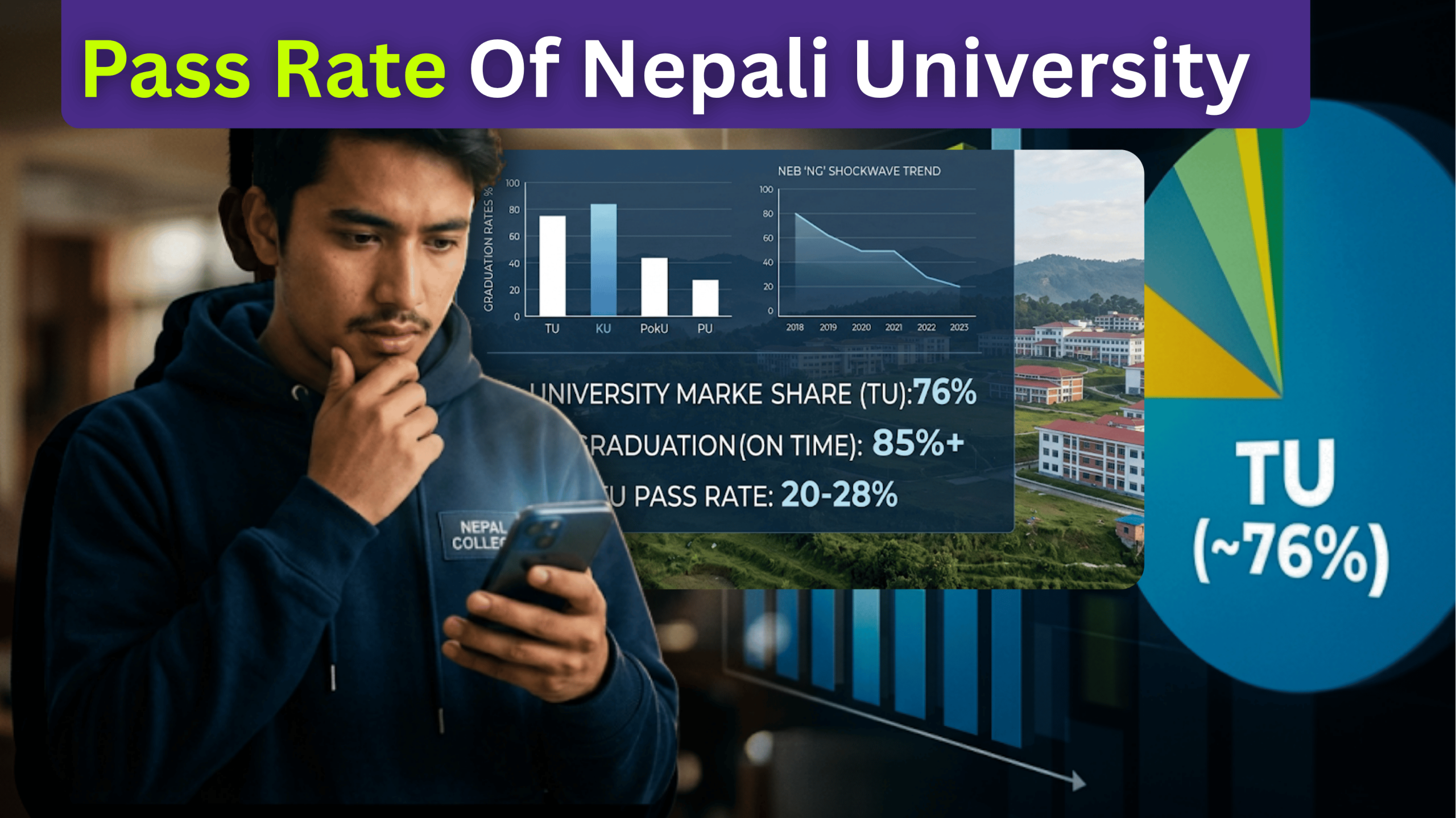
Where Do Nepali Students Go? (University Market Share)

 ▒▒▒▒▒▒▒▒▒▒▒▒▒▒▒▒▒▒▒▒▒▒▒▒▒▒▒▒▒▒▒▒▒▒▒▒▒▒▒  TU (~76%)
 ▒▒▒  Pokhara University (~7%)
 ▒▒  Purbanchal University (~6%)
 ▒  Kathmandu University (~4%)
 ░  Others (Mid-West, Far-West, etc. ~7%)
Tribhuvan University (TU) – The Overloaded Giant
With over 1,100 constituent and affiliated campuses, TU educates roughly three-quarters of all college students in Nepal. If you graduate in Nepal, odds are your certificate has TU stamped on it.
- The Pass Rate Bottleneck: Because of its sheer size, TU struggles with efficiency. The average pass rate for general, non-technical faculties like Humanities, Education, and BBS (Bachelor of Business Studies) often hovers around a frustrating 20% to 28% in yearly board exams.
- The Timeline Trap: A standard 4-year bachelor’s degree under TU can sometimes stretch into 5 years due to delayed exam schedules and months spent waiting for results.
Kathmandu University (KU) – The Clockwork Exception
On the complete opposite end of the spectrum is Kathmandu University. Holding just about 4% of the student market share, KU operates like a private enterprise.
- They strictly follow their academic calendar.
- Their graduation output is incredibly high—often 85% to 90% of an incoming batch graduates exactly on time, especially in highly competitive fields like Engineering and MBBS.
Pokhara (PokU) & Purbanchal (PU) Universities – The Technical Mid-Ground
Capturing about 7% and 6% of students respectively, these two universities rely heavily on private affiliated colleges. Their board exam pass rates generally sit between 40% and 55%. They are highly popular for practical IT and management courses (like BBA and BCA) because their exams are semester-based, which naturally keeps pass rates higher than TU’s annual system.
3. Which Stream Gives You the Best Chance of Graduating?
Not all degrees are graded equally. The data shows that technical, entrance-filtered streams have vastly higher passing rates than open-enrollment programs.
| Faculty / Stream | Student Volume | Avg. Board Pass Rate | The Reality Behind the Numbers |
| Management (BBS/BBA) | Highest (~46%) | 30% - 45% | Because anyone can join BBS, the failure rate in the first and second years is high. However, due to massive enrollment, it still produces the highest total number of graduates in Nepal. |
| Engineering (BE) | Low (~6.6%) | 60% - 75% | The IOE (Institute of Engineering) entrance exam filters out everyone except the top students. Because the intake is elite, the final board pass rates are naturally high. |
| Medical (MBBS/BNS) | Low (~6.4%) | 85% + | Medical colleges have intense internal monitoring. If you don't pass the internal send-ups, they won't let you sit for the university boards. Plus, the pressure of the NMC license exam keeps students studying. |
| Humanities & Education | Moderate (~28%) | 20% - 30% | These faculties suffer from high dropout rates. Many students register for exams but skip classes to work or prepare to go abroad, leading to very low official pass rates. |
4. Where Are the Most Graduates Coming From?
If you want to look at which specific colleges are pumping out the most graduates, you have to look at two different metrics: Volume vs. Efficiency.
The Volume Leaders (Major Public Campuses)
If we talk about pure numbers, massive government-run constituent campuses take the crown. Campuses like Shanker Dev (Management), Prithvi Narayan Campus in Pokhara, Patan Multiple Campus, and the Amrit Science Campus (ASCOL) handle thousands of students per shift. Shanker Dev alone produces more business graduates than dozens of private colleges combined.
The Efficiency Leaders (Top Private Colleges)
If your definition of "best" is a college where almost every student in the classroom passes the board exam, premier private institutions take the lead. Private engineering colleges under TU (like Kathmandu Engineering College or Advanced College of Engineering) and boutique management colleges in Kathmandu valley regularly boast 90%+ pass rates.
Why? Because they operate like high schools: they track daily attendance, hold mandatory internal assessments, and provide extra tuition classes for struggling students.
5. The Invisible Factors Shaping Today's Statistics
When analyzing these pass rates, we have to look at the cultural shifts happening across Nepal right now:
- The "Waiting for Visa" Factor: Walk into a third-year BBS classroom in a public college, and you will notice half the benches are empty. A significant number of students enroll in college as a backup plan while trying to clear their IELTS/PTE scores to go abroad. When visa approvals come through, they drop out, which heavily skews the final exam pass rates negatively.
- The Annual vs. Semester System Divide: Semester-system courses (BBA, BIM, BCA) consistently see higher pass rates than annual-system courses (BBS, BA). It is simply easier for a student to memorize and pass 5 subjects every six months than to study 5 massive books all at once at the end of the year.
The Bottom Line
If you are looking for an affordable education and can handle independent study without a professor holding your hand, Nepal's historic public campuses (like Shanker Dev or central university departments) will give you a recognized degree alongside thousands of peers.
However, if you want a strict environment where you are pushed to graduate on time without losing years to academic delays, investing in Kathmandu University or a reputable, high-performing private affiliated college is statistically the safer bet.
Confused about your choices? Don't rely on billboards alone. Head over to our verified directory atnepalicollege.comto compare real student reviews, historical pass rates, and accurate fee structures for colleges across Nepal.






)