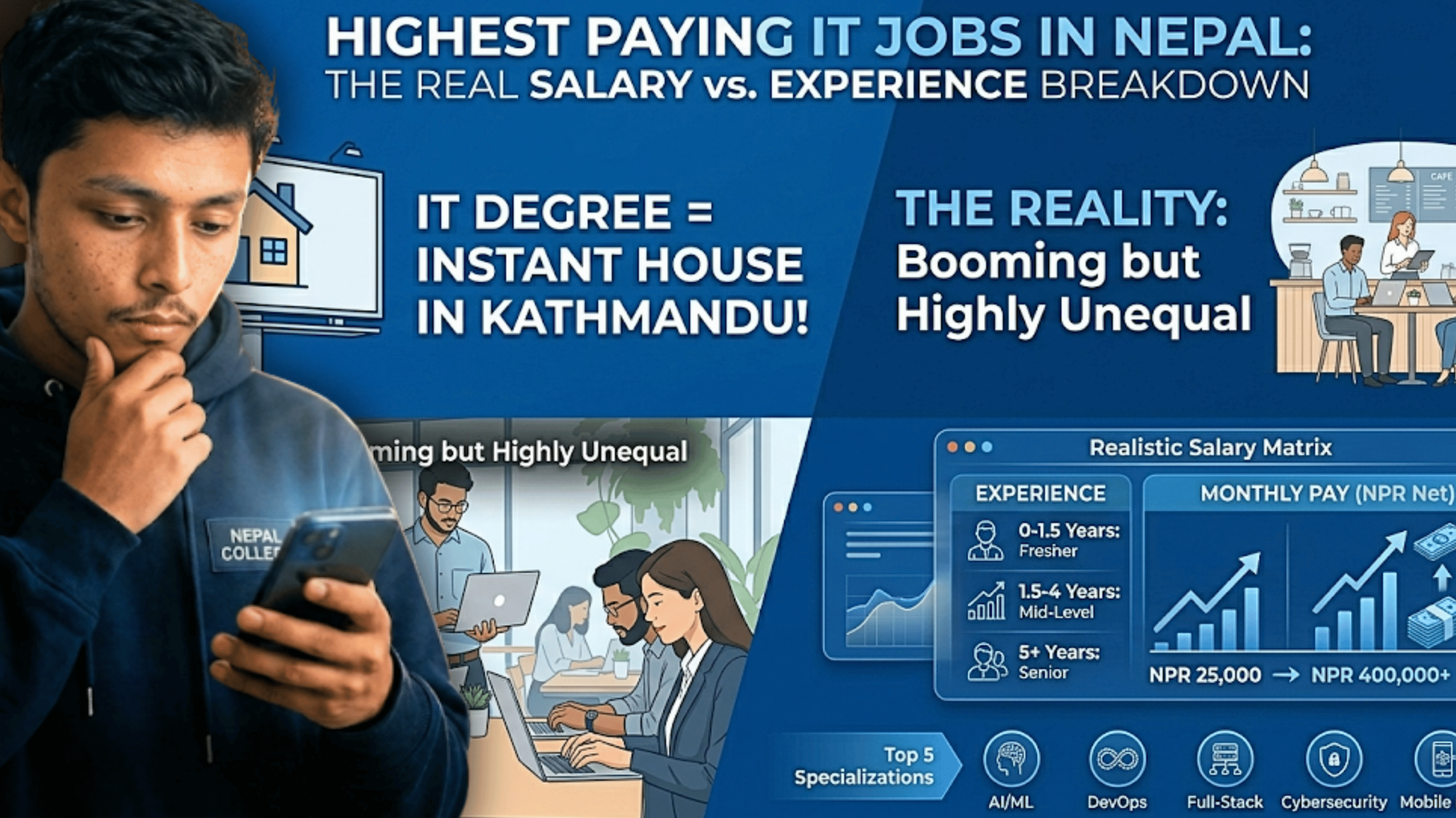
Highest Paying IT Jobs in Nepal: The Real Salary vs. Experience Breakdown
Let’s be completely honest. When you drive down the Ring Road and see giant college billboards, or when you scroll through TikTok videos promising that an IT degree will instantly buy you a house in Kathmandu, it’s easy to feel a bit cynical. Every institution promises “100% placement,” but nobody ever shows you the actual cash flow entering a developer’s bank account.
The reality of the tech industry in Nepal is booming, but it is also highly unequal. A fresh graduate doing basic template editing might struggle to pay their monthly room rent, while a senior engineer working from a quiet cafe in Jhamsikhel could be making more than a corporate bank manager.
If you are a student or a recent graduate trying to map out your future, you need hard numbers, not vague motivational quotes. Let’s lift the curtain on what mid-to-top tier tech companies in Kathmandu, Lalitpur, and Pokhara actually pay their engineering staff.
Understanding Nepal’s Three-Tier Tech Ecosystem
Before looking at specific job titles, you must realize that your monthly paycheck doesn’t just depend on what you know—it depends heavily on who you work for. The domestic market is split into three distinct financial realities:
- Local Software Houses: These are smaller companies catering to local businesses (building local e-commerce sites, basic inventory apps, or restaurant menus). Salaries here are modest, often starting below the living wage for freshers.
- International Outsourcing Giants: Companies based in Kathmandu but owned by or solely serving US, European, or Australian tech firms (e.g., Cotiviti, Logpoint, Leapfrog, Deerhold, Cedar Gate). They offer excellent local salary structures, medical insurance, and proper corporate growth.
- Direct Remote Work & Freelancing: Individual engineers living in Nepal but working directly for overseas startups via platforms like Turing, Toptal, or LinkedIn. They earn directly in USD. This is where the eye-watering numbers come from.
Top 5 Highest-Paying IT Specializations in Nepal
1. AI & Machine Learning (ML) Engineer
With the global shift toward automation and intelligent data systems, AI and Machine Learning roles command the absolute highest premiums in the country right now. Companies are searching desperately for talent capable of building data pipelines, training models, and integrating modern Large Language Models (LLMs).
- The Premium Factor: The talent pool inside Nepal is tiny. Most local universities only teach outdated textbook theory, meaning anyone with a portfolio of functional AI projects can dictate their own price.
- Core Core Stack: Python, PyTorch, TensorFlow, SQL, Data Engineering.
2. DevOps Engineer & Cloud Architect
A DevOps engineer is the critical bridge between software development and live server operations. They make sure that when half a million people open apps like eSewa, Khalti, or Fonepay during a major festival, the entire framework doesn’t crash under pressure.
- The Premium Factor: If a software feature has a bug, developers fix it in the next update. If the cloud infrastructure goes down, the business loses millions every single minute. High-stakes liability directly equates to a high salary.
- Core Core Stack: AWS (Amazon Web Services), Docker, Kubernetes, CI/CD Pipelines, Linux.
3. Senior Full-Stack Developer (Node.js / React / Python)
While the market is flooded with juniors who only know basic frontend styling, true “Full-Stack” engineers—those who can design a clean user interface, manage complex backend logic, and architect efficient databases—are constantly hunted.
- The Premium Factor: Outsourcing companies love versatile engineers because they can take complete ownership of an international client’s project without requiring a massive, multi-person team.
- Core Core Stack: TypeScript, React, Node.js, PostgreSQL,(MongoDB), Next.js.
4. Cybersecurity Analyst & Ethical Hacker
As Nepal’s banking, fintech, and governmental portals shift entirely online, cyber threats have skyrocketed. Top-tier banks and corporate IT firms pay significant sums to specialists who can audit security flaws and protect user data from breach risks.
- The Premium Factor: Data breaches ruin corporate brands overnight. Ethical hackers protect the company’s survival, making them invaluable assets.
- Core Core Stack: Penetration Testing, Network Security, CEH (Certified Ethical Hacker) practices, OWASP Top 10.
5. Mobile App Developer (Flutter / iOS Native)
Nepal is a mobile-first country. Most consumers skip desktop sites entirely. Businesses understand this, creating a massive, continuous demand for developers who can launch clean, highly optimized applications on iOS and Android.
- The Premium Factor: Native iOS (Swift) developers are incredibly scarce due to the high cost of Apple hardware in Nepal, driving up their market value substantially.
- Core Core Stack: Flutter, Dart, React Native, Swift (iOS), Kotlin (Android),JAVA.
The Realistic Salary Matrix: Experience vs. Monthly Pay
The table below reflects genuine net monthly salaries (after taxes) across mid-to-top-tier tech firms operating inside Nepal.
Disclaimer: These are industry averages for established outsourcing tech hubs in Kathmandu Valley. Small local startups may pay lower baselines, while direct remote USD roles can easily exceed the senior caps listed here.
| Job Role | Entry-Level / Fresher(0 – 1.5 Years) | Mid-Level Engineer(1.5 – 4 Years) | Senior / Lead Engineer(5+ Years) |
| AI / ML Engineer | NPR 35,000 – 65,000 | NPR 80,000 – 160,000 | NPR 200,000 – 400,000+ |
| DevOps / Cloud Specialist | NPR 30,000 – 60,000 | NPR 65,000 – 150,000 | NPR 200,000 – 350,000+ |
| Full-Stack Developer | NPR 25,000 – 50,000 | NPR 55,000 – 130,000 | NPR 150,000 – 300,000 |
| Cybersecurity Analyst | NPR 25,000 – 55,000 | NPR 80,000 – 140,000 | NPR 170,000 – 320,000 |
| Mobile App Developer | NPR 30,000 – 50,000 | NPR 70,000 – 125,000 | NPR 150,000 – 280,000 |
Bypassing the “Freshman Trap” in Kathmandu
Looking at the matrix above, the income jump from a fresher to a mid-level engineer is massive. The hardest hurdle in the Nepali IT journey is getting your foot in the door for that very first job. Most local companies complain that university graduates possess a piece of paper but have no idea how to pull code from a Git branch or resolve a basic merge conflict.
If you want to skip the low-paying exploitation phase and jump straight into a high-tier fresher salary, you need to supplement your college syllabus:
- Ditch the CV Fluff, Build Public Portfolios: Senior developers evaluating your application don’t care about your college GPA or your high school attendance records. They look directly at your GitHub link. Build three functional projects that address real-world issues and host them live.
- Infiltrate Local Tech Communities: Attend local developer meetups, WordPress circles, Flutter assemblies, and hackathons inside the Valley. A vast majority of lucrative tech openings are filled via professional recommendations and internal referrals before they ever hit job portals.
- Master Technical Communication: Because the highest-paying companies deal directly with Western clients, your ability to articulate your logic clearly in English often matters just as much as your code optimization. Brilliant coders with poor communication skills frequently stay stuck in low-paying backend slots.
The Professional Bottom Line: Tech is one of the few fields in Nepal where traditional nepotism (afno manche culture) matters very little. Your value is determined entirely by the complexity of the problems you can solve. Pick a high-value niche early, protect your study hours during college, and build practical things. The market will take care of the rest.
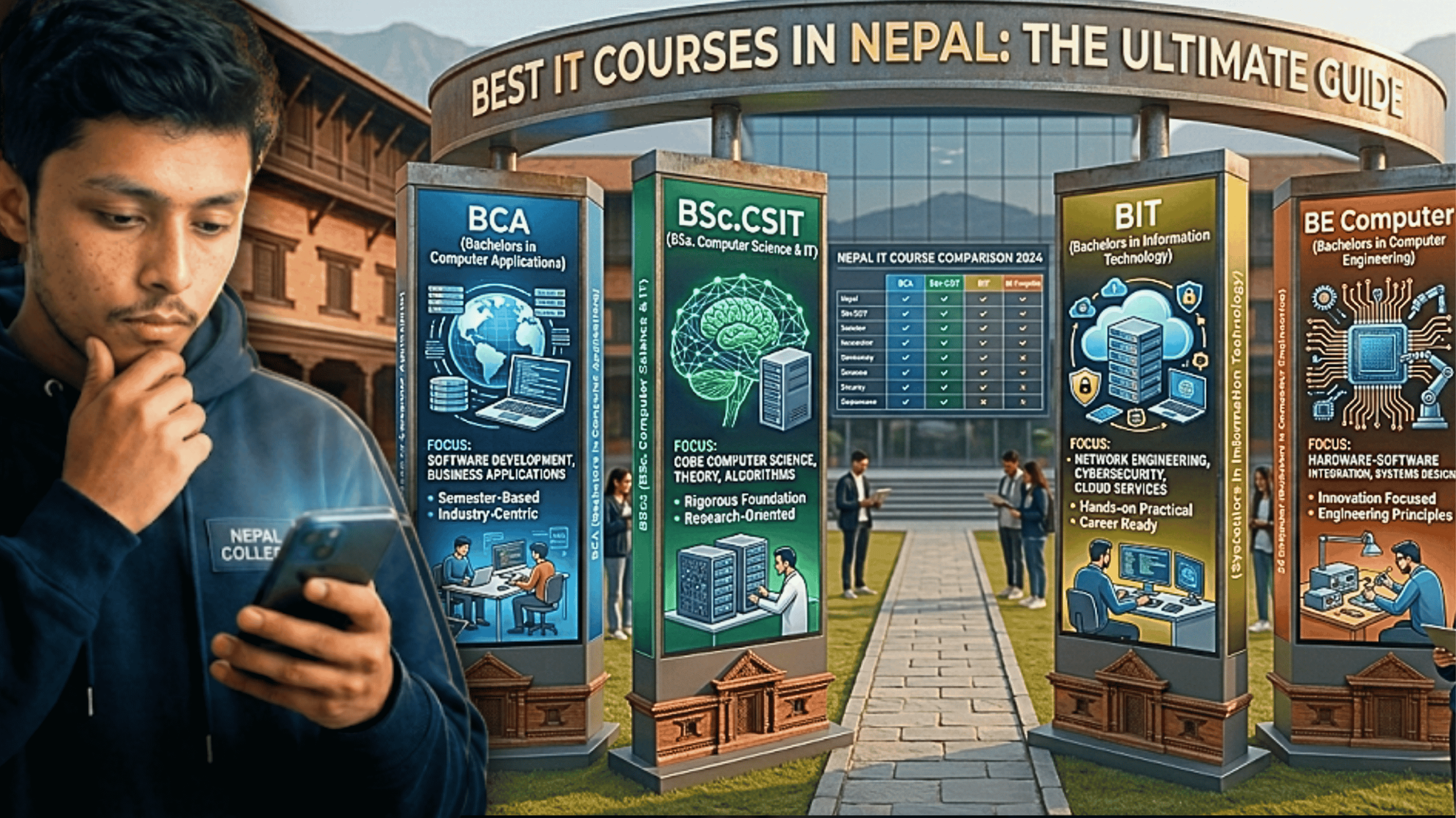
Unsure which university course or college gives you the best schedule flexibility to balance your studies and build a high-income portfolio? Dive into our comprehensive academic comparison tools over at nepalicollege.com to view transparent fee structures and read authentic student reviews.