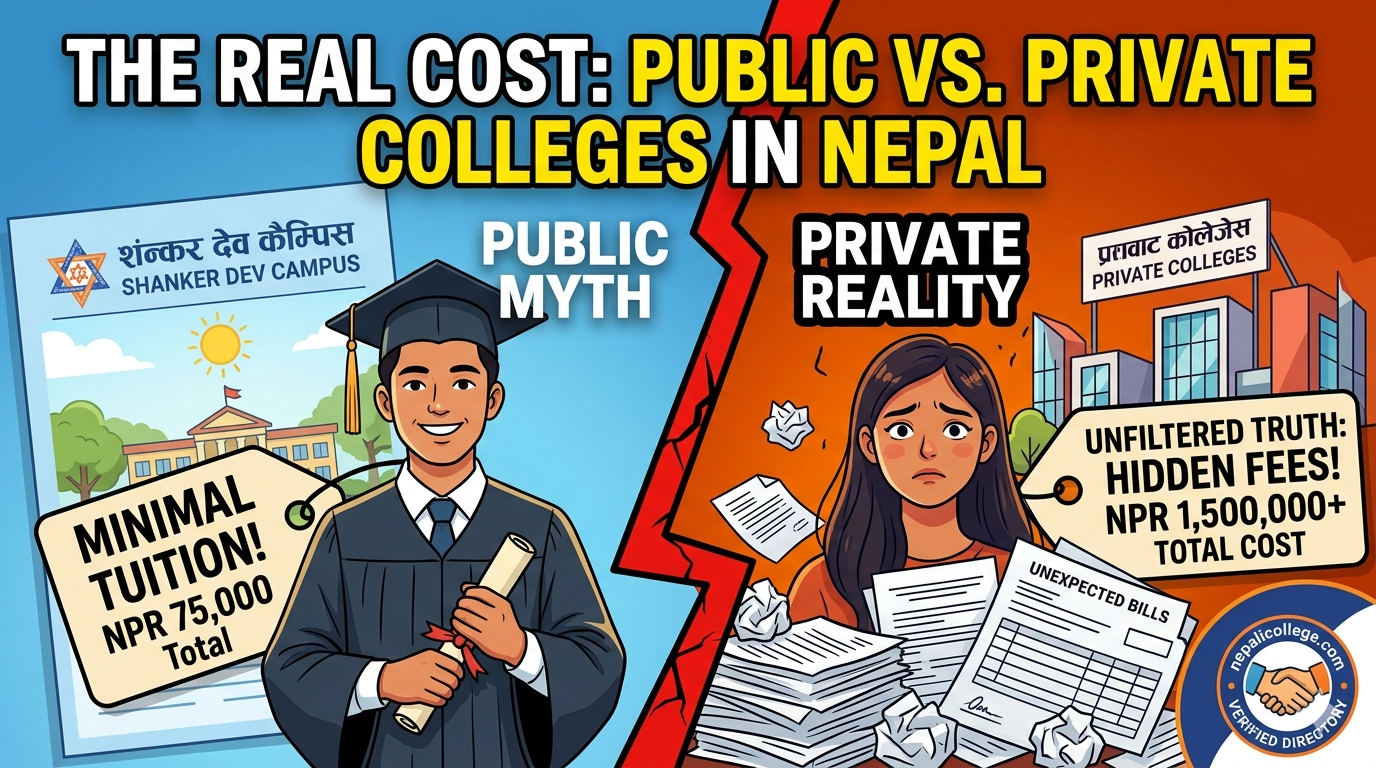
The Real Cost of a Bachelor’s Degree in Nepal: Public vs. Private Fees
Walk down any main street in New Baneshwor, Putalisadak, or Prithvi Chowk, and you cannot escape the massive, glossy college billboards. They show proud graduates holding degrees, claims of 100% placement, and state-of-the-art facilities. But walk into the admissions department, collect their colorful prospectus, and you will notice something peculiar. The sheet labeled “Fee Structure” almost never represents the actual final amount you will pay over the next four years.
For families across Nepal, planning for higher education expenses has turned into a game of financial hide-and-seek. Hidden costs, semester exam fees, university affiliation renewals, security deposits, and sudden project expenses are routinely omitted from that initial brochure quote.
Whether you are a +2 graduate calculating your family’s budget or a parent trying to manage financial planning without taking an unexpected bank loan, this guide lays out the raw truth. Let’s look at the actual costs of public vs. private bachelor programs in Nepal and expose the real-world expenses colleges hide in the fine print.
The Real Cost Comparison: Public vs. Private
Let’s bypass the standard marketing pitches and look directly at what a four-year bachelor’s degree actually costs when you add up the semesters. The massive cost difference below shows exactly why competition for government seats is so fierce.
Estimated 4-Year Total Investment Map
| Faculty / Program Type | Government Constituent Campuses (TU) | Private Affiliated Colleges (TU / PokU / PU) | Autonomous University (KU Core Campus) |
| Management (Traditional BBS) | NPR 45,000 – 85,000 | NPR 2,500,000 – 4,000,000 (If converted to BBA) | Not Applicable |
| Management (Professional BBA) | NPR 350,000 – 450,000 | NPR 600,000 – 950,000 | NPR 850,000 – 1,100,000 |
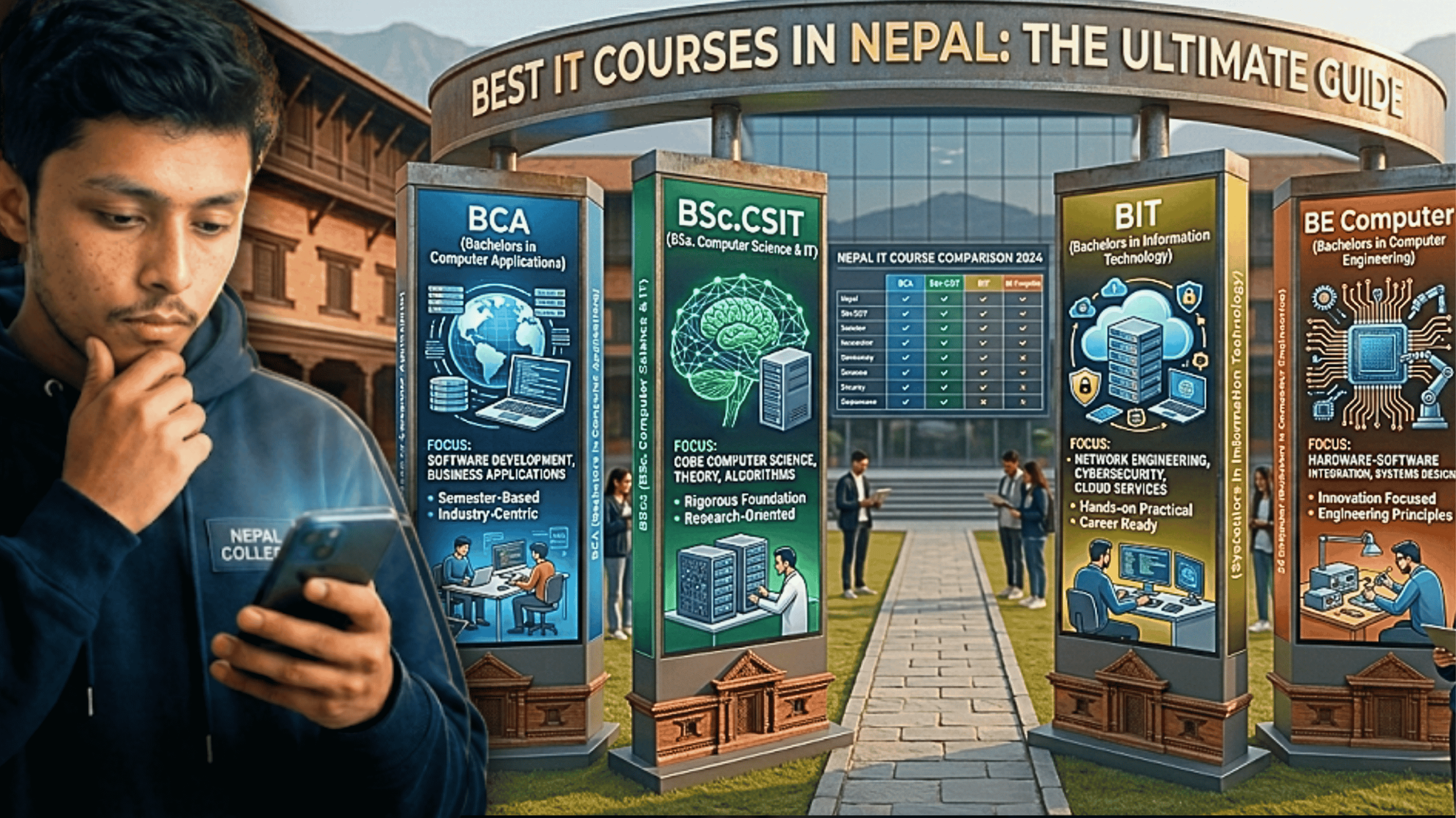
| IT & Computing (BSc.CSIT / BIT / BCA) | NPR 300,000 – 450,000 | NPR 650,000 – 1,100,000 | NPR 900,000 – 1,200,000 |
| Engineering (Civil / Computer / IT) | NPR 350,000 – 550,000 | NPR 950,000 – 1,500,000 | NPR 1,100,000 – 1,400,000 |
Management Fees: The Massive Divide Between BBS and BBA
Management programs draw the largest volume of students in Nepal, but the pricing within this single faculty is split wide open. Your choice generally comes down to the old-school, annual system or the modern, semester-based professional degrees.
The Shanker Dev BBS Fee Structure Reality:
If you want to earn a highly respected management degree without draining your family’s savings, the Shanker Dev BBS fee structure is the clear winner. Because Shanker Dev is a direct constituent campus of Tribhuvan University, its general programs are heavily subsidized by the government.
For the regular morning shifts, the complete 4-year BBS course costs between NPR 45,000 and NPR 65,000 total. Even if you enroll in the full-paying evening shifts, the final cost rarely crosses NPR 85,000.
The real trade-off here isn’t the money; it’s the environment. Classes are highly packed, administrative tasks take time, and your academic success depends entirely on your own personal drive.
Private BBA College Fees in Kathmandu:
If you transition over to a modern, semester-based Bachelor of Business Administration, the price skyrockets. Private BBA college fees in Kathmandu operate on a premium commercial model.
An 8-semester BBA program at a top-tier private college affiliated with TU, Pokhara University (PokU), or Purbanchal University (PU) inside the valley will cost you anywhere between NPR 600,000 and NPR 950,000.
With this higher price tag, private colleges cover air-conditioned infrastructure, presentation workshops, mandatory industrial tours, and a structured high-school-style environment that keeps track of your daily attendance.
Engineering Fees: Fighting for a Government Subsidized Seat
Engineering remains one of the costliest undergraduate career paths in Nepal, forcing students to prepare months in advance for highly competitive entrance filters.
The Cheapest Engineering Colleges Under TU
To get a low-cost engineering degree, you have to target the constituent campuses running under the Institute of Engineering (IOE). The cheapest engineering colleges under TU are the main government-run campuses:
- Pulchowk Campus (Kathmandu)
- Thapathali Campus (Kathmandu)
- Paschimanchal Campus / WRC (Pokhara)
- Purwanchal Campus / ERC (Dharan)
If your IOE entrance exam rank is high enough to secure a Regular Seat, your total 4-year tuition fee is only around NPR 350,000. However, if you clear the exam but miss the top cutoff ranks, you fall into the Full-Fee Quota at these exact same government campuses, which bumps the cost up to roughly NPR 850,000.
While eight and a half lakhs sounds expensive for a public college, it is still far cheaper than private engineering colleges (such as Kathmandu Engineering College or Advanced College of Engineering). In those private institutions, the base tuition alone easily runs from NPR 1,200,000 to NPR 1,500,000 before you buy any project field books or pay university board fees.
The Premium Standard: Kathmandu University (KU)
Kathmandu University operates on its own model out of Dhulikhel. KU does not follow the cheap public model of TU, nor does it operate like a profit-driven private setup.
The Kathmandu University fee structure 2026 is built on a cost-recovery system. For their signature School of Engineering and School of Science programs, the total 4-year cost ranges between NPR 1,100,000 and NPR 1,400,000.
The primary reason parents choose this significant investment is predictability. Unlike public campuses where political delays or administrative strikes can turn a 4-year program into a 5-year wait, KU completes its courses on the exact date promised in the calendar. Furthermore, what they state in their admission notice is exactly what you pay; they don’t surprise you with unexpected extra fees halfway through your third year.
Exposing the Hidden Costs in the Fine Print
This is the information you will not find inside an admission prospectus. When planning your higher education budget, you must factor in these invisible charges that are often hidden until after you sign the admission papers:
A. University Registration & Examination Fees
Private colleges handle their own in-house operations, but they are bound to external universities like TU or PokU. Every single semester, you will write a separate check for university board registration and exam form processing. This easily adds an extra NPR 5,000 to NPR 10,000 per semester to your real out-of-pocket expenses.
B. The Non-Refundable Deposit Catch
Almost every private college asks for a “Security Deposit” and a “Library Deposit” during admission, usually totaling anywhere from NPR 10,000 to NPR 30,000. While they state this money is fully refundable when you graduate, processing delays, admin paperwork, or minor deductions for textbook delays mean many students never see the full amount back.
C. Laboratory, Fieldwork, and Project Assessments
If you choose a practical technical field like IT, Computer Science, or Engineering, you cannot escape projects. Many private colleges don’t cover the costs of external examiners, specialized software licensing, or mandatory field transport. This forces students to pay separate fees out of pocket during their final semesters to clear their projects.
The Summary: Which Path Fits Your Budget?
- Go with Public Constituent Campuses if: You are working with a tight budget, can crack highly competitive entrance exams, have the self-discipline to study independently without anyone checking your daily attendance, and can handle shifting exam schedules.
- Go with Kathmandu University (KU) if: You can afford a steady mid-to-high fee structure, want a guaranteed, predictable graduation date, and want a highly respected degree with clean global credibility.
- Go with Private Affiliated Colleges if: You want a structured, high-school-style learning environment inside Kathmandu with strict attendance tracking, modern infrastructure, and close parental reporting.



)
