Difference Between CSIT and BIT in Nepal (BCA & BE Added)
The moment the NEB Class 12 results are published, every tech-aspirant in Nepal faces the exact same dilemma. Your relatives start giving unsolicited advice, college billboards on the Ring Road look identical, and you find yourself staring at an alphabet soup of degrees: BSc.CSIT, BIT, BCA, and BE Computer.
They all promise the same thing: a glittering career in IT, a laptop lifestyle, and a paycheck in US dollars. But underneath the marketing slogans, these four courses are radically different. Picking the wrong one can lead to four years of academic misery, especially if you hate advanced mathematics or prefer coding over hardware engineering.
Let’s skip the college brochure fluff and look at the real difference between CSIT and BIT in Nepal, how BCA opens doors for non-science students, and which path actually fits your career goals.
The Big Four: A Quick Snapshot
Before we dive deep, let’s look at how these courses stack up in the real world:
IT Degrees in Nepal: Theory vs. Practical Application

BE Computer (High Math / Heavy Engineering)
BSc.CSIT (High Math / Pure Computer Science)
BIT (Moderate Math / Industry Focused)
BCA (Low Math / Application & Management
1. BSc.CSIT (Bachelor of Science in Computer Science and Information Technology)
The Verdict: The Academic Heavyweight.
If you graduated from the Science stream (+2 Science or A-Levels) and want a rigorous, deep-dive education into the core fundamentals of computing, BSc.CSIT is the gold standard in Nepal. Heavily dominated by Tribhuvan University (TU), this course treats computer science as a pure science.
- The Core Focus: Algorithms, computation theory, database architecture, and operating systems. You don’t just learn how to code; you learn how computers think.
- The Math Hurdle: Very High. If calculus and discrete structures make you sweat, think twice. CSIT requires a solid foundation in mathematics.
- Eligibility: You must have a background in +2 Science (with Physics and Mathematics) and clear the highly competitive TU CSIT Entrance Exam.
2. BIT (Bachelor of Information Technology)
The Verdict: The Modern Industry Favorite.
A common query among students is the difference between CSIT and BIT in Nepal. While CSIT focuses on the “why,” BIT focuses on the “how.” It strips away a lot of the heavy theoretical physics and abstract math to focus on the practical application of technology in business.
- The Core Focus: Software development, network administration, web technologies, and cloud computing. It is designed to get you job-ready for the local and global tech market faster.
- The Math Hurdle: Moderate. There is math, but it is applied and generally far more manageable than the calculus found in CSIT or Engineering.
- University Affiliations: Offered widely by TU, Pokhara University (PokU), Purbanchal University (PU), and highly popular British/foreign university-affiliated colleges in Kathmandu.
3. BCA (Bachelor of Computer Application)
The Verdict: The Ultimate Gate-Opener for Non-Science Streams.
For a long time, if you took Management, Arts, or Humanities in +2, an IT career was considered out of reach. BCA completely changed that. It is designed to blend computer applications with management principles.
- The Core Focus: Application development, UI/UX basics, business communication, and system analysis.
- The Math Hurdle: Low. The mathematics involved is basic and tailored to logical problem-solving rather than advanced calculus.
- Which IT course is best for average students? If you consider yourself an average student in mathematics or come from a Management background, BCA is undoubtedly the best path into tech without the risk of failing rigorous math boards.
4. BE Computer (Bachelor of Engineering in Computer)
The Verdict: The Prestigious All-Rounder.
Run under the IOE (Institute of Engineering) for TU, as well as Kathmandu University (KU), Computer Engineering is for those who want the prestigious “Engineer” tag and are equally interested in hardware and software.
- The Core Focus: Microprocessors, electronics, hardware circuits, embedded systems, alongside software engineering.
- The Math/Physics Hurdle: Extreme. You will face intense engineering mathematics, physics, and chemistry in your initial semesters.
- The Reality: It is a demanding 4-year journey. If you only want to build mobile apps or websites, the hardware and physics requirements of this course might feel like unnecessary baggage.
Head-to-Head Comparison: University & Requirements
| Metric | BE Computer | BSc.CSIT | BIT | BCA |
| Primary University | TU (IOE), KU, PokU | TU, FWU | TU, PokU, PU, Foreign | TU, PokU, POU |
| +2 Stream Required | Science Only | Science Only | Science / Management* | Any Stream (Min. D+ or GPA 2.0) |
| Math Intensity | 10/10 | 8.5/10 | 5/10 | 3/10 |
| System | Semester | Semester | Semester | Semester |
| Ideal For | Hardware + Software | Core Software & AI | App Dev & Networking | Software & IT Management |
*Note: Some domestic universities require math/computer background for BIT, whereas foreign-affiliated colleges often accept all streams.
Navigating the Universities: Domestic vs. Foreign Affiliation
When scouting the best IT colleges in Kathmandu, you will quickly realize you have to choose between two systems:
1. National Universities (TU, KU, PokU)
- The Pros: High brand value in Nepal, highly affordable tuition fees (especially in constituent public campuses), and a structured degree recognized globally for government jobs and public exams.
- The Cons: TU can occasionally suffer from delayed exam schedules or bureaucratic friction. Entry requirements (entrance exams) are highly competitive.
2. Foreign-Affiliated Colleges (UK, US, Malaysian Degrees)
Colleges running British or international degrees in Kathmandu have skyrocketed in popularity.
- The Pros: Updated, fast-paced syllabi that change based on global tech trends. Strict adherence to calendars (you graduate exactly in 3 or 4 years). Often no rigid science-stream requirement for IT.
- The Cons: Significantly higher tuition fees. Furthermore, ensure the college possesses the mandatory Equivalence Certification from TU (Curriculum Development Centre) so your degree is recognized legally within Nepal.
Making the Choice: Which One is Right For You?
Let’s personalize this choice. Strip away the peer pressure and look at where you fit:
- Go for BE Computer or BSc.CSIT if: You love science, scored well in +2 Mathematics, want a deep understanding of core computation, or plan to head straight into academic research, AI development, or systems engineering.
- Go for BIT if: You want a balanced life. You want to learn modern programming frameworks, skip abstract physics, build software, and start working in a local software hub or freelance market as soon as possible.
- Go for BCA if: You came from a Management or Arts background, or you consider yourself an average student who finds advanced calculus intimidating but still possesses a strong passion for coding, design, and digital systems.
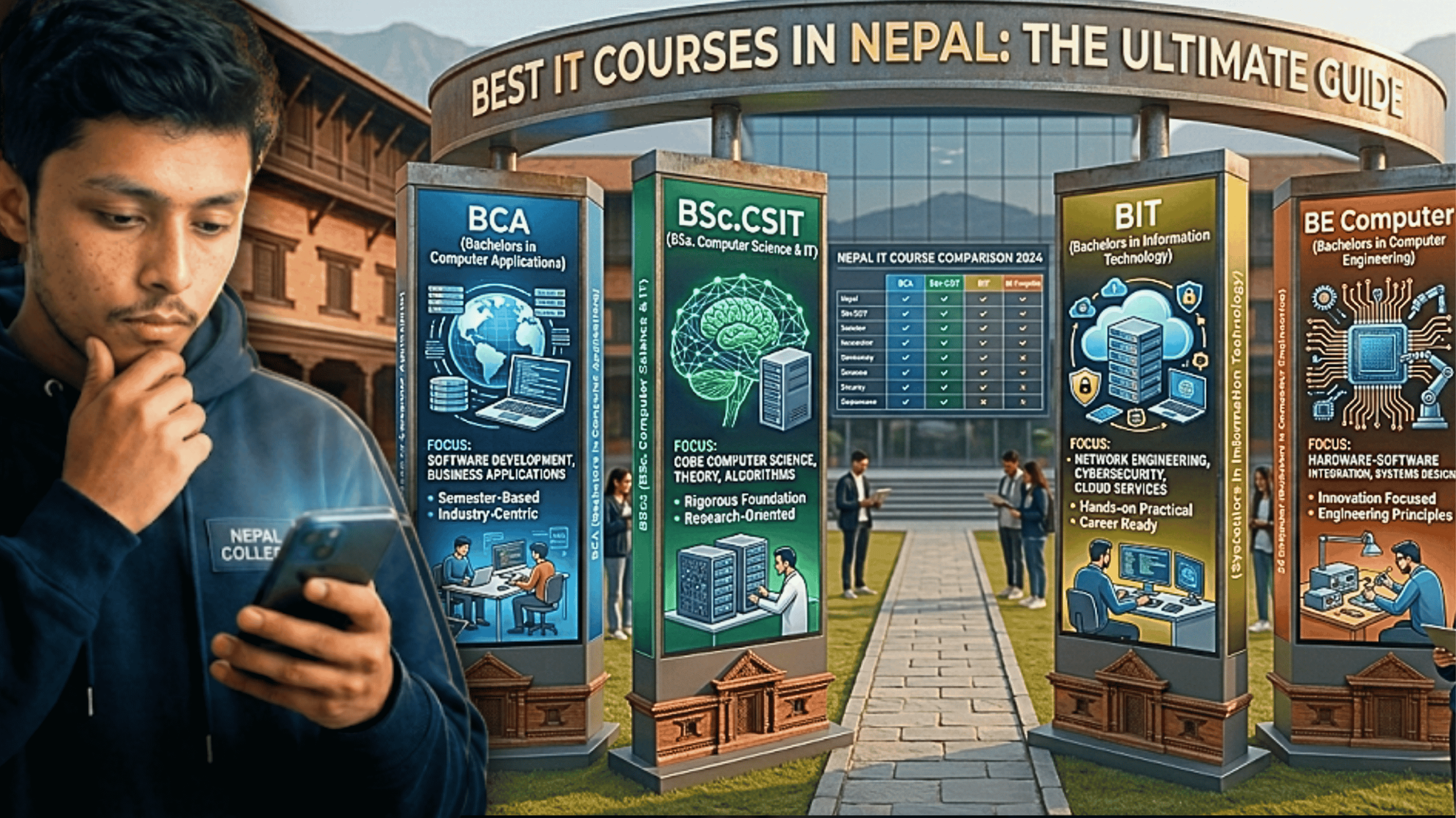
Best IT Courses in Nepal
The Summary:
There is no “perfect” degree; there is only the right degree for your specific skills and patience levels. In the modern tech world, companies like Leapfrog, Logpoint, or global remote employers care 90% about your GitHub portfolio, your problem-solving skills, and your grit—and only 10% about the specific letters printed on your degree certificate.
Still undecided? Don’t make a blind decision. Explore our complete database of the best IT colleges in Kathmandu, compare real fee structures, and check entrance exam syllabus guides over atnepalicollege.com.