Is Paying 10 Lakhs for BPH in Nepal a Financial Suicide? (The 2026 Reality Check)
Is BPH Paying worth in Nepal
The MEC (Medical Education Commission) results are out. You checked your rank. You checked it again. And then, the realization hit you like a cold splash of water: You missed the Scholarship.
Now, you are standing at a crossroads.
On one side, there is the option to drop a year, join a PEA or Vibrant entrance class again, and face the same pressure next year.
On the other side, there is the “Paying Seat.”

Form:https://forms.gle/gzNQFkhEPbq3embs7
Your father is doing the math on the back of an envelope.
“Babu, 10 Lakhs for the fee… plus hostel… plus food… it will cross 15 Lakhs.”
He looks at you and asks the question that is keeping you awake at night:
“Is it worth it? Will you get a job that pays this back?”
It’s a terrifying question. 15 Lakhs is not a small amount. For a middle-class Nepali family, that’s a piece of land in the Terai or the savings of a lifetime.
I’m not here to give you a motivational speech. I’m here to look at the numbers. I’ve interviewed DPHOs (District Public Health Officers), NGO Country Directors, and fresh graduates who are currently unemployed.
Let’s be brutally honest about the 2026 Session. Is a BPH paying seat an investment or a trap?
Is BPH Paying worth in Nepal
The Short Answer :
Is a BPH Paying Seat worth the cost in Nepal?
The short answer is: Yes, but only if you aim for the “Big Three” sectors: Government (7th Level), INGOs, or Academia.
If you plan to work in a private hospital as an administrator, the ROI is terrible (it will take 10+ years to recover the cost). However, for students who crack the Lok Sewa Aayog or land a job at a UN agency, the investment of NPR 10 Lakhs is usually recovered within 3 to 4 years. It is a high-risk, high-reward game in 2026.
The “10 Lakh” Headache: Understanding the Cost
Let’s get the numbers straight first.
In 2026, the MEC has fixed the fees, but we all know there are “hidden” costs.
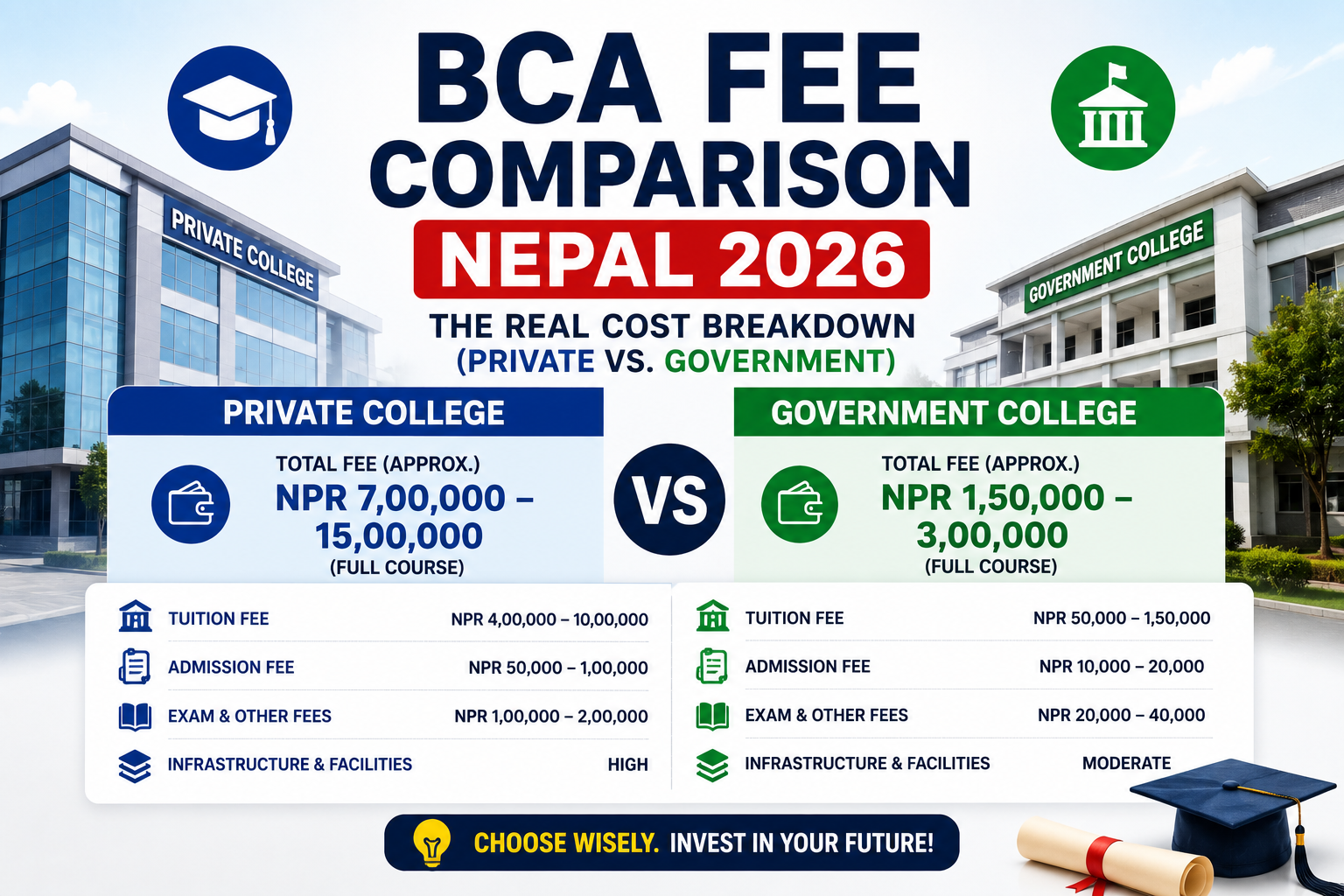
- Tuition Fee: Approx NPR 7.5 to 8 Lakhs (depending on the university).
- Hostel & Food: NPR 10,000 – 15,000 per month.
- Field Visits/Research: NPR 50,000+ (Public Health requires travel).
- Total 4-Year Cost: Approx NPR 12 – 15 Lakhs.
Now, compare this to the “Middle Class” reality.
If your parents are taking a loan at 12% interest from a cooperative or bank, the pressure on you to perform is massive. You aren’t just studying; you are carrying a mortgage on your back.
The ROI Calculation: When Will You Break Even?
This is the table your dad wants to see. Show him this.
We are comparing three scenarios for a BPH graduate in 2026.
(Note: ROI = Return on Investment. How fast you get your money back.)
| Career Path | Starting Salary (Monthly) | Time to Recover 15 Lakhs |
| Private Hospital (Admin) | NPR 20,000 – 25,000 | 6 – 7 Years (Don’t do this) |
| Local NGO (Field Officer) | NPR 35,000 – 45,000 | 3 – 4 Years (Decent) |
| Govt Officer (7th Level) | NPR 50,000 + Benefits | 2.5 – 3 Years (Best) |
The Ugly Truth:
Look at the first row.
If you graduate and take a job at a private hospital or a small polyclinic in Kathmandu, they will exploit you. They will offer you Rs. 18,000.
If you accept that job, paying 15 Lakhs for your degree was a bad business decision. You would have been better off putting that money in a Fixed Deposit at Nabil Bank.
The Golden Ticket:
But look at the last row.
If you crack Lok Sewa (Public Health Officer), your official salary is around Rs. 45k-50k. But with “Field Allowances,” “Training Allowances,” and the pension security, the value is massive. This is why people fight for paying seats.
The “Hidden” Value: Why Smart Students Pay
So, why are colleges like Nobel, Chitwan Medical College, and PU constituent campuses full of paying students? Are they all rich? No.
They know something you don’t.
1. The “Officer” Shortcut
This is the biggest secret.
If you study Nursing or Lab Technology, you often start your government career at Assistant Level (5th Level).
If you study BPH, you are eligible for Officer Level (7th Level) immediately after graduation.
You skip the lower ranks. In the government hierarchy, jumping from 5th to 7th level can take 10 years of service. BPH gives you that jump instantly. That jump alone is worth 10 Lakhs.
2. The “Dollar” Economy
Nepal is run by NGOs.
USAID, DFID, WHO, UNICEF, Save the Children.
They don’t hire doctors to run their field programs; they hire Public Health Officers.
An entry-level job in an International NGO (INGO) pays Rs. 60,000 to Rs. 80,000.
If you land one of these jobs, you pay off your dad’s loan in 2 years.
3. The “Master’s” Gateway
If you want to go to the USA or Australia later, BPH is a strong foundation.
Universities in the US love Nepali BPH graduates for their MPH (Master of Public Health) programs because Nepal is a “tropical disease hub.” You have real-world experience with Dengue and Typhoid that an American student only reads about in books. This leads to scholarships (Graduate Assistantships) abroad.
The Risk Factor: Who Should NOT Pay?
I want to be responsible here. I don’t want you to waste your family’s money if you aren’t cut out for this.
Do NOT take a paying seat if:
- You are shy: Public Health is 100% communication. You have to talk to Mayors, rural mothers, and angry stakeholders. If you can’t speak up, you won’t get the NGO job.
- You want to live in Kathmandu only: The real money and the real jobs are in the districts. Karnali, Sudurpaschim, Madhesh. If you refuse to leave the valley, you will be unemployed.
- You think the degree is enough: It’s not. In 2026, you need skills: SPSS (Data Analysis), Report Writing (in English), and Proposal Writing. If you graduate without these, your degree is just paper.
Step-by-Step: How to Decide Tonight
Sit down with your parents. Put the emotional drama aside. Follow this checklist.
Step 1: The Financial Stress Test
Can your family afford the 10-15 Lakhs without selling their primary source of income (like the main shop or the house)?
- If Yes: Go for it.
- If No: Consider a cheaper course (like B.Ed in Health) or try for a scholarship again. The stress of a loan can destroy your study performance.
Step 2: The College Audit
Not all paying seats are equal.
If you are paying 8 Lakhs, demand quality.
- Does the college have a Community Diagnosis Program?
- Do they have alumni working in Lok Sewa?
- Tip: Don’t join a college just because it’s in Kathmandu. A college in Chitwan or Pokhara might have better community exposure.
Step 3: The Career Commitment
Are you willing to spend 6 months preparing for Lok Sewa after you graduate?
Because that is the game. If you treat BPH as a “chill course,” you will regret paying the money. If you treat it as a “pre-Lok Sewa” course, it’s the best investment ever.
User Intent FAQs (The Questions You Are Too Scared to Ask)
Q: “Dai, is there a difference between a Scholarship graduate and a Paying graduate in the job market?”
Zero.
When you sit for the Lok Sewa exam or an NGO interview, nobody asks if you paid or got a scholarship. They ask: “Can you analyze this data set?” or “Can you write a program proposal?” Your skill matters, not your admission category.
Q: “Can I work part-time to pay my fees?”
It’s very hard. BPH requires field visits (going to villages for weeks). A 9-5 job is impossible. You might make some pocket money doing data entry or tuition, but don’t expect to pay your 10 Lakh fee by working while studying.
Q: “What if I don’t get a government job?”
Then you hustle in the NGO sector. Or you apply for a Master’s abroad. The unemployment rate for skilled BPH grads is low. The unemployment rate for lazy BPH grads is high.
Final Verdict: The “Dai” Advice
Here is the deal.
Paying for BPH is not like buying a luxury bike. It’s not an expense; it’s a capital investment.
But like any business investment, it carries risk.
If you are lazy, if you just want a certificate to hang on the wall, do not pay. Save that 10 Lakhs and open a chiya pasal or a fancy momo shop; you will earn more.
But…
If you are ambitious.
If you see yourself leading a health project in a rural district.
If you want the prestige of a Section Officer (7th Level) without waiting until you are 40.
Then, yes. The 10 Lakhs is a bargain.
The salary of a Public Health Officer will cover that cost in 3 years. The prestige will last a lifetime.
Make the decision based on your hunger, not just your wallet.
Still confused about which college offers the best value for money?
Drop the names of the colleges you are considering in the comments. I’ll tell you which ones are worth the cash and which ones are just buildings with no faculty.
(Disclaimer: I am an education journalist. Financial advice is based on current market trends in Nepal for Dec 2025. Always consult your family and bank before taking large loans.)